
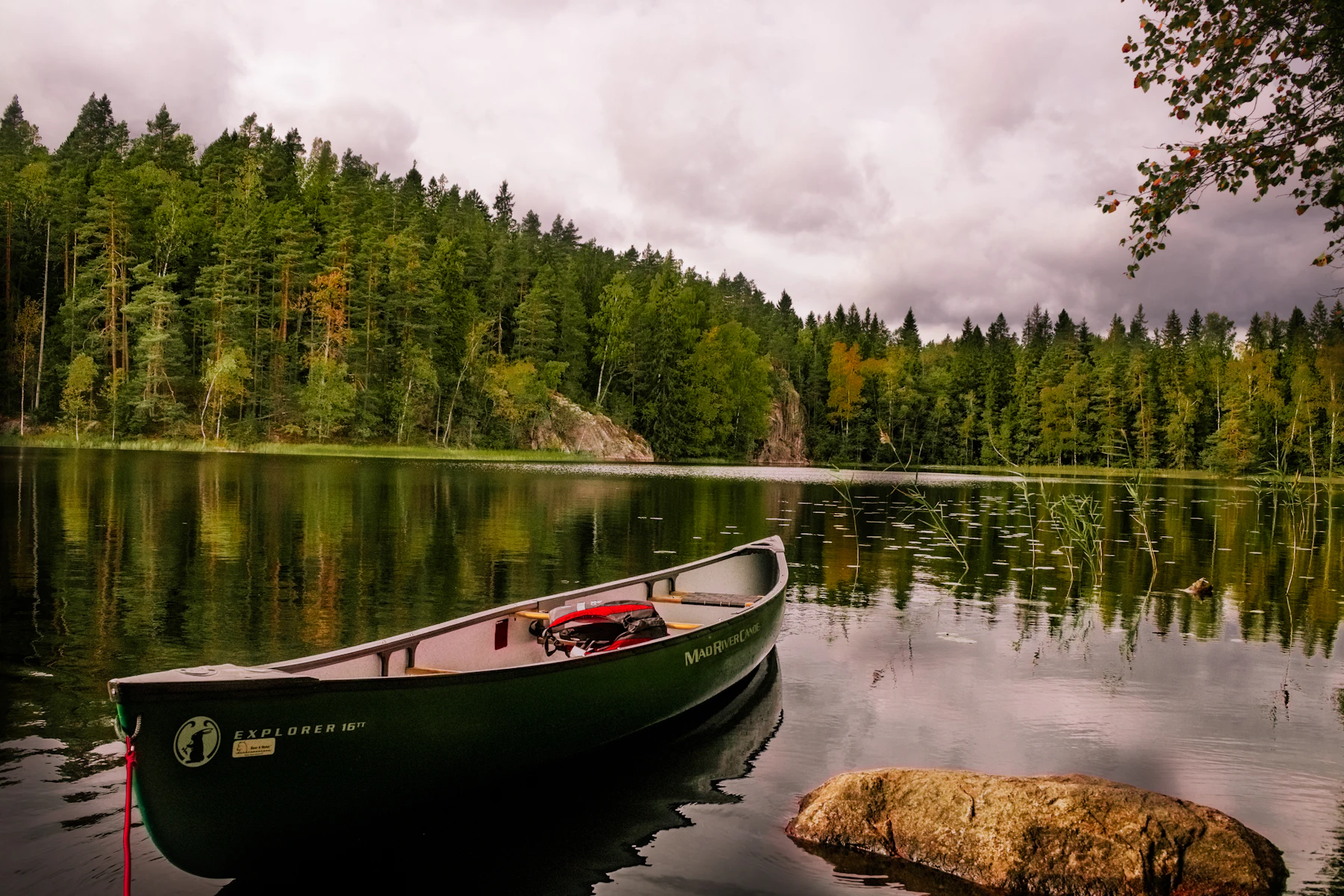
Yes, you can wild camp in Sweden with a tent, and you do not need to ask anyone. Allemansrätten, the right of public access, lets you pitch a tent for a night or two on most land, private land included. What it never covers is a vehicle. In a motorhome or campervan, the overnight stop is a parking question, answered further down. Checked against the Swedish authorities on November 14, 2026.
What the tent rule says
Naturvårdsverket, the Swedish Environmental Protection Agency, publishes the guidance, and its Swedish page on tents is short: you may pitch for “något enstaka dygn,” a single day or so, on ground that can take it. The English handbook says: “one or two nights is the rule of thumb.” A few tents, which the agency puts at two or three, are inside the right. A large group with many tents needs the landowner’s permission.
Two kinds of ground are off limits. Fields with crops or grazing animals, and the private zone around someone’s home.
How far from houses
There is no number. If someone has told you 150 meters for Sweden, that figure is Norway’s: section 9 of the Norwegian outdoor recreation act, friluftsloven, sets it. Sweden’s test is about the people, not a tape measure. The agency’s English handbook puts it this way: people living nearby “shouldn’t be able to see or hear you from their private property, and its surrounding zone. The further away, the better.”
In practice, if you can see a house from your tent, they can probably see you, so move on. A hedge, a road, a ditch or a forest edge often marks the zone. The zone is larger on open, flat ground than in hilly or wooded country, and camping needs more distance than walking past.
Fire bans
Allemansrätten gives you no automatic right to a fire. When the ground is dry, the county administrative board (länsstyrelsen) or the municipality can declare a fire ban, an eldningsförbud. Under an ordinary ban, a fixed barbecue site may still be allowed. Under a stricter ban, a skärpt eldningsförbud, lighting a fire or grilling is often forbidden wherever you are. A ban also applies inside protected areas.
Checking is your job: the county board’s or municipality’s website, or the national fire ban map on krisinformation.se. When there is no ban, light fires on gravel or sand or at a fixed site, never on moss, peat or bare rock, and burn only twigs, branches and cones lying on the ground, never a fallen tree. In dry weather, bring food that does not need cooking.
National parks and nature reserves
Inside a national park or nature reserve, the park’s regulations replace the general right. Naturvårdsverket says camping is usually allowed only at designated places there, and a whole area can be closed to tents. Tyresta National Park, south of Stockholm, shows what that looks like: its regulations (NFS 2016:12) allow tents at the Stensjödal camping area for up to three nights in a row, and at other designated places for one night between 18:00 and 10:00. Nowhere else in the park. The notice board at the entrance shows the rules for each area.
Municipalities can restrict the right too. Most have camping rules in their local ordinances, typically for parks and sports grounds.
Where a motorhome can actually stop
Naturvårdsverket states it flatly: setting up a motorhome, a caravan or a car with a roof tent in nature is not part of allemansrätten. The off-road driving act, terrängkörningslag (1975:1313), section 1, bans driving a motor vehicle in terrain on snow-free ground anywhere in the country, except for farming and forestry. Section 4 sets a fine. Practically all natural land counts as terrain: forests, beaches, pastures, parks and lawns. The act binds landowners too, so a farmer cannot give you permission to park on their field.
Here is what you can do. Beside a road that is not terrain, no general time limit applies, but always ask permission before you park near a house, even for one night. At a rest area, you may stay as a rule for up to 24 hours on weekdays, and until the next weekday on weekends and public holidays, unless a sign says otherwise. Municipalities can set their own rules for motorhomes at rest areas. For prices, ställplatser (motorhome stopovers) and the Trafikverket rest area rules, see our guide to Sweden by motorhome.
The sign wins
A rule posted by a park, a reserve or a municipality beats the general right, and it beats this page. Our Sweden rules page has the framework in short form. The Nordic right to roam comparison sets Sweden beside Norway, Finland and Denmark, and wild camping in Finland covers the country next door, where the vehicle rule is just as strict.
Sources
- The Right of Public Access, Naturvårdsverket, English edition 2025
- Tältning, Naturvårdsverket
- Husvagn, husbil och taktält i naturen, Naturvårdsverket
- Eldning, Naturvårdsverket
- Terrängkörningslag (1975:1313), Sveriges riksdag
- Naturvårdsverkets föreskrifter om Tyresta nationalpark (NFS 2016:12)
- Lov om friluftslivet (friluftsloven), Lovdata
When a source is not in English, follow the link for the official wording.